How to Get a Cohere API Key
Create a Cohere account at dashboard.cohere.com, copy your auto-generated trial API key from the dashboard, store it securely, then integrate with Bifrost for virtual keys, budgets, and cost governance. Complete setup in minutes.
Cohere provider summary
Bifrost supports Cohere models through Cohere-compatible HTTP APIs and standard JSON request shapes.
| Property | Details |
|---|---|
| Description | Cohere provides advanced LLMs for chat, search, embeddings, and reasoning workloads. |
| Provider route on Bifrost | cohere/<model> |
| Provider doc | Cohere |
| API endpoint for provider | https://api.cohere.com/v2 |
| Supported endpoints | /v1/models, /v1/chat/completions, /v1/responses, /v1/embeddings, /v1/count-tokens, /v1/rerank |
Official Cohere Resources
Use these Cohere-hosted links for console access, API documentation, and authentication details.
Prerequisites
Before you begin, you will need:
[ QUICK START ]
How Do You Get a Cohere API Key in 5 Steps?
Create or sign in to a Cohere account
Use the Cohere Dashboard.
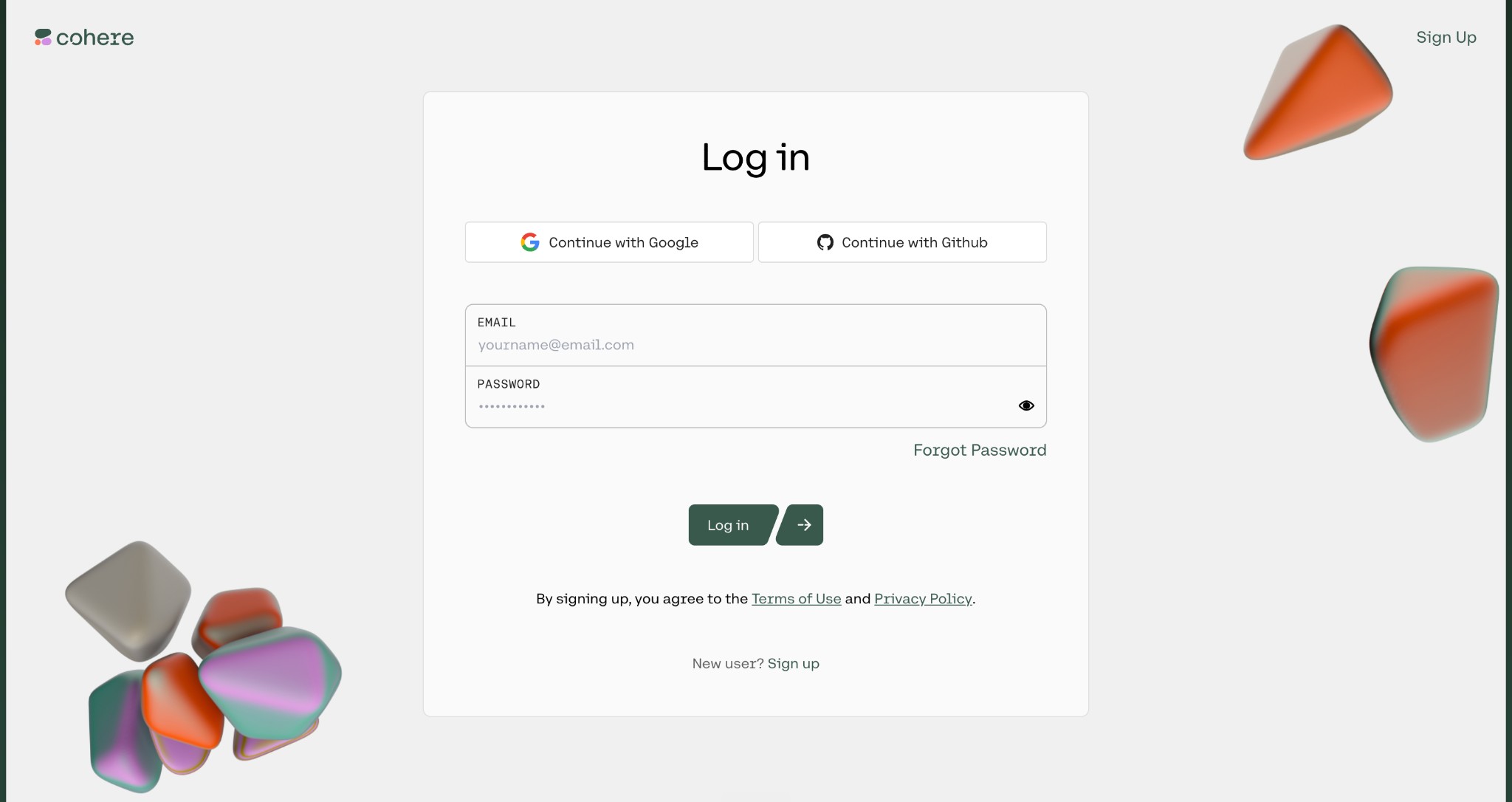
Go to dashboard.cohere.com and sign up or log in with email, Google, or GitHub. Registration typically takes under a minute.
Open API Keys in the dashboard
A trial API key is created automatically.
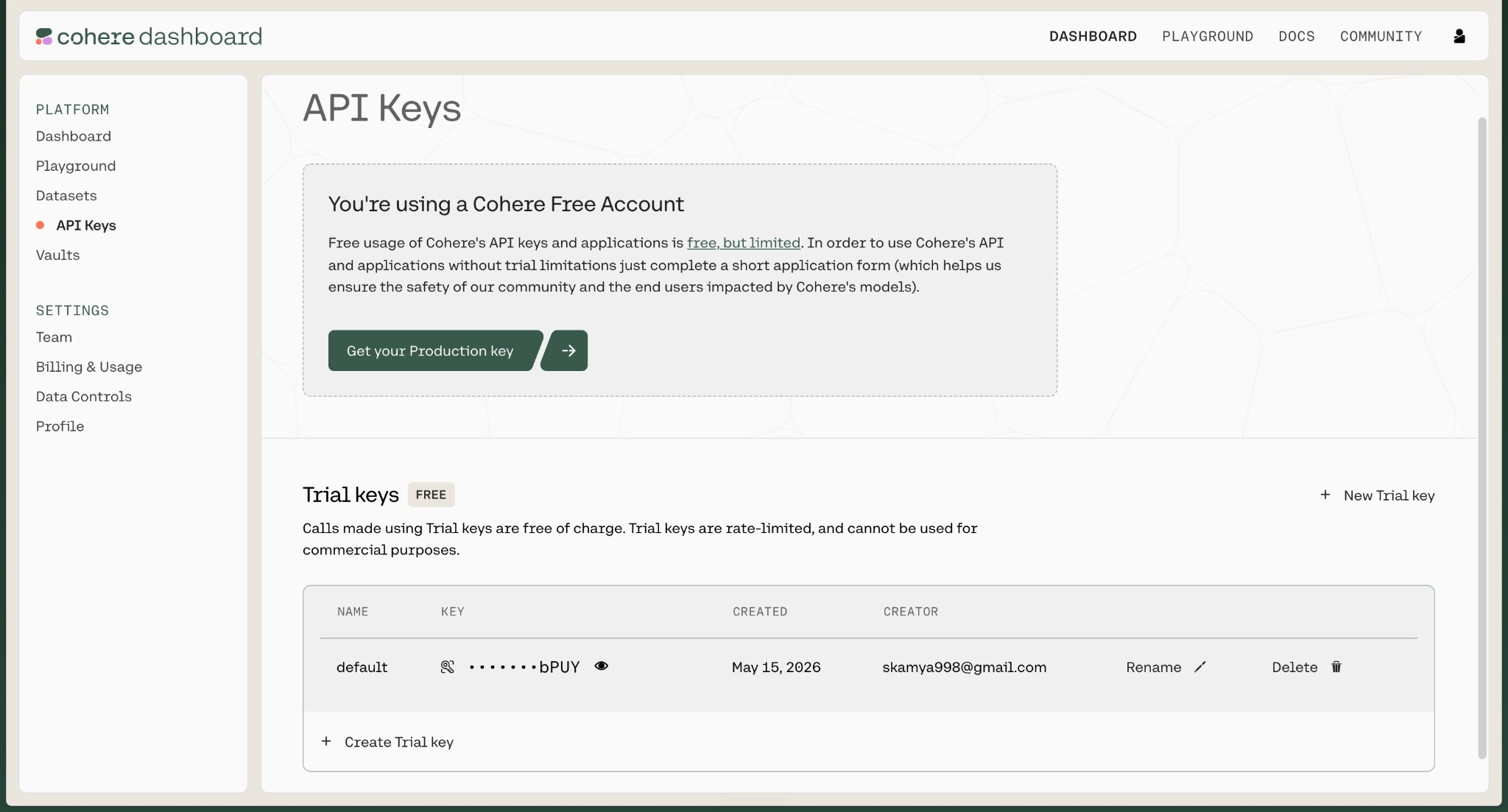
After you sign up, Cohere redirects you to the dashboard and automatically creates a trial API key. In the left sidebar under Platform, click API Keys, your trial key appears in the Trial keys section (free, rate-limited, for development).
Copy your API key from API Keys
In the dashboard sidebar, open API Keys. Your trial key is listed there, copy it with one click. Keys start with co-.
Store your API key securely
Export as an environment variable so SDKs can read it automatically.
Paste your key into a local environment variable (macOS / Linux):
export COHERE_API_KEY="co-..."
Make your first Chat API call
Authenticate with Bearer tokens per Cohere's API reference.
Cohere's API uses Authorization: Bearer COHERE_API_KEY for REST calls. Example call to the chat endpoint:
$ curl https://api.cohere.com/v1/chat \
  -H "Content-Type: application/json" \
  -H "Authorization: Bearer $COHERE_API_KEY" \
  -d '{
    "model": "command-r-plus",
    "messages": [{"role":"user","content":"Hello!"}]
  }'
[ MODELS ]
Available Cohere Models
| Model | API ID | Best for |
|---|---|---|
| Command A | command-a-03-2025 | Flagship Cohere model for enterprise agents. |
| Command R+ | command-r-plus-08-2024 | Complex RAG and multi-step tool use. |
| Command R | command-r-08-2024 | Balanced RAG and conversational AI. |
| Command R7B | command-r7b-12-2024 | Smaller Command tier for lower latency. |
| Command Light | command-light | Fast, economical text generation. |
| Embed v4 | embed-v4.0 | Latest Cohere embeddings. |
| Embed English v3 | embed-english-v3.0 | English semantic search and RAG. |
| Embed Multilingual v3 | embed-multilingual-v3.0 | Multilingual embedding workloads. |
| Rerank 3.5 | rerank-v3.5 | Improving retrieval ranking in RAG. |
Models and availability change over time. See the Cohere's models documentation for the latest list and pricing.
[ TROUBLESHOOTING ]
Troubleshooting Common Cohere API Errors
| Error | Likely Cause | What to Do |
|---|---|---|
401 Unauthorized | Invalid or missing API key in Authorization header. | Verify your API key is correct. Generate a new key if needed. |
400 Bad Request | Invalid request format or unsupported model. | Check request format and confirm model ID is valid. |
429 Rate Limited | Trial key limits (20 requests/min on chat, 1,000 calls/month total) or production rate limits exceeded. | Implement exponential backoff. Upgrade to a production key when you need higher limits. Use Bifrost for rate limit management. |
503 Service Unavailable | Cohere API is temporarily unavailable. | Retry after a delay. Check Cohere status page. Configure failover with Bifrost. |
[ PRODUCTION-READY ]
Use Your Cohere Key with Bifrost
Bifrost is a drop-in replacement for Cohere SDKs: keep your client code and change the base URL to your gateway. Bifrost handles cost tracking, virtual keys, budgets, and failover automatically.
Step 1: Start Bifrost and register Cohere
Run the Bifrost gateway and configure your Cohere credentials in the Web UI.
$ npx -y @maximhq/bifrost
✓ Bifrost started
├─ HTTP server listening on http://localhost:8080
├─ Web UI available at   http://localhost:8080
└─ Configure providers and virtual keys in the dashboard
Step 2: Point your Cohere SDK at Bifrost
Update your SDK to route through Bifrost's gateway instead of the direct Cohere endpoint.
from cohere import ClientV2

# BEFORE
# client = ClientV2(api_key="your-cohere-key")

# AFTER: route via Bifrost + virtual key
client = ClientV2(
    api_key="sk-bf-your-virtual-key",
    base_url="http://localhost:8080/cohere"
)

response = client.chat(
    model="command-r-plus",
    messages=[{"role": "user", "content": "Hello from Bifrost!"}]
)

print(response.message.content[0].text)
x-bf-vk or Authorization: Bearer sk-bf-* per the Bifrost documentation.[ WHAT'S NEXT ]
Explore Bifrost Resources
You have your API key. Add governance, guardrails, and MCP controls for production.
[ BIFROST FEATURES ]
Open Source & Enterprise
Everything you need to run AI in production, from free open source to enterprise-grade features.
01 Governance
SAML support for SSO and Role-based access control and policy enforcement for team collaboration.
02 Adaptive Load Balancing
Automatically optimizes traffic distribution across provider keys and models based on real-time performance metrics.
03 Cluster Mode
High availability deployment with automatic failover and load balancing. Peer-to-peer clustering where every instance is equal.
04 Alerts
Real-time notifications for budget limits, failures, and performance issues on Email, Slack, PagerDuty, Teams, Webhook and more.
05 Log Exports
Export and analyze request logs, traces, and telemetry data from Bifrost with enterprise-grade data export capabilities for compliance, monitoring, and analytics.
06 Audit Logs
Comprehensive logging and audit trails for compliance and debugging.
07 Vault Support
Secure API key management with HashiCorp Vault, AWS Secrets Manager, Google Secret Manager, and Azure Key Vault integration.
08 VPC Deployment
Deploy Bifrost within your private cloud infrastructure with VPC isolation, custom networking, and enhanced security controls.
09 Guardrails
Automatically detect and block unsafe model outputs with real-time policy enforcement and content moderation across all agents.
[ SHIP RELIABLE AI ]
Try Bifrost Enterprise with a 14-day Free Trial
Drop-in replacement for any AI SDK
Change just one line of code. Works with OpenAI, Anthropic, Vercel AI SDK, LangChain, and more.
[ FAQ ]
Frequently Asked Questions
Yes. When you create an account, Cohere automatically generates a trial API key. Trial keys are free for testing and development, include monthly usage limits (1,000 total API calls per month), and do not require a payment method to get started.
Cohere API keys are long alphanumeric strings beginning with "co-". Store them securely as environment variables and never commit them to version control.
Use Bearer token authentication with the Authorization: Bearer <YOUR_API_KEY> header on REST calls. Official Cohere SDKs handle authentication automatically when initialized with your key.
Yes, one key works everywhere. For better tracking and security, use the dashboard to create separate keys per environment (for example development, staging, and production).
Immediately revoke the exposed key from the Cohere dashboard under API Keys and generate a new one. The old key stops working instantly. Update all applications to use the new key.
Trial keys are created automatically at signup and are suited for prototyping (lower per-minute rate limits and 1,000 calls per month). Production keys require billing setup in dashboard settings and unlock higher rate limits and pay-as-you-go usage. Upgrade only when your app outgrows trial limits.